Monday, April 25, 2011

Monday 25th: Easter Bunny versus Lame Donkey; a Bulgarian Easter

It’s Easter or was Easter, if we have to abide the calendar, but we’re still riding on the Easter high. In Bulgaria [as well as in all Eastern Orthodox countries] Easter ranks second in the list of holidays. In Greece people take one week off from work before Easter and one week after Easter. I love Easter, because it used to get me days off from school, hard boiled eggs and the sweet Easter bread with the consistency of cotton and taste of heaven.

Growing up, however, I felt quite conflicted about Easter traditions. My family was one of the first to have cable TV – hence my introduction to the wonderful world of Cartoon Network – which led to learning about the Easter Bunny, the egg hunt and the chocolate eggs. This all happened after communism fell, so Bulgaria could now smuggle in Easter Bunny stickers. Let me tell you that they only deepened my confusion as I certainly asked about the Bunny and I was told by my grandparents that we didn’t have one.

No, what we had was the Lame Donkey. The Lame Donkey is a magical donkey – I think it’s the donkey that Jesus rode on as he entered Jerusalem – that enters the homes of sleeping kids on Saturday night and leaves a hardboiled egg [painted red to symbolize Christ’s blood] next or under the pillow of said sleeping child. I used to be terrified, because I don’t think donkeys are nice or adorable and limping animals freaked me out – mainly because I can’t stare at any sort of deformation or abnormality.

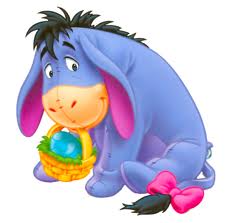
I remember enjoying the hardboiled egg though, so the very least I was rewarded for having the patience with this story. Now, nobody knows about the Lame Donkey. It’s so obscure I’m not even sure I didn’t make this up [grandparents confirmed I’m typing the truth]. Funny, yet creepy crossover is that I remember Eeyore carrying a basket full of Easter eggs. To me this was yet again confusing, cause Eeyore is a rather drowsy type with a falling tail.


I have the evidence to prove this, even though the Internet is quiet about it.

The other great misconception I had about Easter was that I would go on an Easter egg hunt, like kids in US movies had. No such thing. No chocolate eggs either. The egg tradition in my country is rather different. For one we use real hardboiled eggs, which we ritualistically paint on either Thursday or Saturday. In the old days the color always was red – Christ’s blood – but now we can go rainbow on the eggs. The real fun starts on Sunday, when all of the family gathers and starts ‘battling’. Basically we crack egg top against egg top and then egg bottom against egg bottom to determine the champion egg. The champion egg should have won all the battles and has to be preserved for the whole year in order to bring health and prosperity.

Psychedelic egg action.

In summary, my childhood Easter had aggression and limping livestock, while my cousins in the US had Mr.Fluffykins and chocolate. Honestly, I think I’m special because I have a very different folklore icon [making me a cultural hipster] and I like hardboiled egg salad, so I’m not very cheated.

Saturday, April 23, 2011

Saturday, April 23rd: Return to an Online Existence and Edits

I’m back and I have a brand new template. Fear me. In truth, I have been exhausted. It’s been a burnout that has been going on since the year started and I can only deal with the exhaustion in intermissions. I started a day job, one that requires going at regular office times, but have a very irregular days off scheme. Suddenly, I had to deal with handling promotion for TZF and work in an office and then came the university, which strained the balancing act.

However, I adapted to the work hours, the work I have to do as well as the time off before and after work. With this in mind, I feel like I can return back to the Internet. I’m yearning for the good old days of Twitter and Google Reader action.

Writing suffered the most, since I decided to lead a social life along with balancing two jobs. I did manage to complete Draft 4 of “Crimson Cacophony” – two months after the planned and realistic deadline – but that brings me closer to my goal. I need two more rounds of editing, one before sending it to my alpha and one after my alpha read it. Then will come mandatory beta hunting and one third final round [three total] before I start the agent hunt.

That’s long in the future, but then again I will have passed the Seven Stages of Writing. Now, “Crimson Cacophony” stands at 60,000 words [with 40,000 scratched off and done anew], but I gather that after the fleshing out I will get to 75,000 words to 80,000. I’m not saying that the wordcount is an adequate measurement of progress, but length matters [or at least that’s what she said].

How was your April, people? Did you manage to complete something?

Thursday, March 24, 2011

My Culture Posts have inspired The Writer's International Culture Share

My cultural posts might bring the crowds that I hope, considering that I have taken a hiatus from blogging as it is, but I have managed to inspire one of the nicest and most in tune with worldbuilding authors I know, Juliette Wade to start a project of her own:

What if there were a place on the web where writers from all over the world - including the US - could share folklore, local culture, religious stories and details of daily life that would be difficult or nearly impossible to discover through ordinary web research avenues?


Welcome to The Writer's International Culture Share. Yeah, I am the muse, which inspired this project. The project will be hosted every Thursday. Right at the moment, Juliette is reposting my first cultural posts from this blog as well as her posts on Japan. Quite thrilling. We are expecting to have people tag along from all over the globe.

Monday, March 21, 2011

Being a Phantom Menace

I know it's been a long radio silence and by the likes of it I may continue with the radio silence. I'm fairly busy with my manuscript and handling things in real life, which is kinda why I probably will not be around much on here, until I sort the incredulous list of tasks I have to handle.

Thanks for the patience. Love ya.

Tuesday, March 8, 2011

[State of the Reader] Reading in Bulgarian

I'm not making the headway I wanted with the edits. I had a very busy weekend, which I spent in the company of other people [yeah, I'm surprised I did that as well] and had very little time to sit down and edit [naturally, the holes that I had filled up with official duty as a marketing maven]. I have nothing to report on that front, but I hope to make a difference this week.

As far as my reading goes, I manage to steal several pages in bus rides or when I decide that my of so worked fingers need to rest. The bizarre coincidence is that my main reads are both in Bulgarian and it's odd to read in my mother tongue. Since I review in English, I prefer to read my materials in English, because of the names. I'm terrible at names and when they are translated, the task grows a lot more complicated.

As is the case with "Game of Thrones". I'm reading this brick in Bulgarian and while the translation is adequate, there are god knows how many names being thrown right from the start. So yeah, I finally got around to working on that project [read GoT and compare it to the TV series as they air episode after episode]. I just hope that I manage to watch the series in order to make it happen, because let me tell you, watching things in Bulgaria is quite the challenge.

For pleasure [yes, I actually hope to read books that I won't have to review] I'm reading a super old edition of "The Birds" by Daphne du Maurier. The translation is from 1983, which makes the book older than I am and the lineup is pretty bizarre, because I can't find all the stories, but that may have to do with the translation rather than anything else. I've watched the Hitchcock movie and now that I'm reading the original novelette, I'm surprised that there is almost no correlation between the text and the motion picture.

Saturday, March 5, 2011

Open Anthology: Bloody Fabulous edited by Ekaterina Sedia

It's finally happened. Fashion has come forth and it shall rule! I know that this may seem a bit out of the blue, but I'm interested in couture fashion. Actually, the first attempts at writing fiction were more or less related to paragraphs of how the characters dressed or the infamous magic girl scenes of transformations [Sailor Moon style]. Of course, I have no actual knowledge of fashion. Just the appreciation of aesthetics that can be achieved. Nevertheless, I'm thrilled when a piece of clothing acquires power or importance.

This is why, upon hearing that Ekaterina Sedia will be editing an anthology, where fashion has to be on the forefront, I did a Mexican wave [which is surprisingly easy now that I have characters by the hundreds]. Here is the premise. I think that I will submit something.


“Bloody Fabulous:

Lace. Leather coats. Open collars over exquisite collarbones. A single red drop on paper-white cuffs. Each fiction genre has its sartorial signifiers, and urban fantasy is no exception – from the brocade extravagance of the Unseelie courts to the ubiquitous leather of supernatural detectives to the old-fashioned good taste of wealthy vampires, we are as familiar with them as we are with the supernatural attributes of the protagonists. However, despite the prominence of clothing in urban fantasy, fashion is usually a supporting actor. In this anthology, we want to give it a center stage (or a runway). Let the tales of tormented designers and well-dressed vampires strut into the light, and finally get the attention they deserve. BLOODY FABULOUS is a collection of urban fantasy tales, featuring vampires as well as other supernatural creatures, but focusing on the world of fashion and its intersection with the uncanny. Get ready, get set, get fabulous!”

Friday, March 4, 2011

Personification of Spring in Bulgarian Culture

It's March, the most bipolar month in Bulgaria [to be honest December surpassed it with days, I had to walk with short sleeves OUTSIDE]. It's the month that catches the death of winter and the birth of spring, so from a meteorological standpoint, March can be as cold as January, as rainy as February and as mildly tempered as April.

Baba Marta in her sunny mood

Of course, such erratic weather patterns panicked did a lot to panic Bulgarians back in the time, to the point that we personified March as Baba Marta [or Grandma March for the curious ones] and March is a time, when we honor Baba Marta in hopes for good weather. In olden times, shepherds would freeze up in the mountains with their flocks, because the sunny weather would easily turn to a snowstorm and the people along with the animals would be trapped there. Naturally, no one had the desire to lose their loved ones as well as their livestock to bad weather and this naturally led to the conception of Baba Marta and the month-long series of rituals that are performed in her name. Baba Marta is not only the embodiment of March, but also the very personification of spring, which for Bulgaria is a tough and unpredictable season. Often cold and with rain showers while it's sunny outside.

In this post, I will touch upon the mythological reasoning as to why Baba Marta suffers from her violent mood swings. The most popular belief is that Baba Marta has two brothers: January and February [they are named Golyam Sechko and Maluk Sechko, which I fail to translate], who have anger management issue, hence why it's cold during these months. Basically, both brothers always do something to displease their sister, either drink all the wine or leave their house in an utter mess. This angers Baba Marta, who as their sister is depicted as an old crone with a cane, and snow covers the land. Otherwise, when not provoked, Baba Marta is happy and loving, thus prompting the sun to shine.

Baba Marta during a fit

Sometimes, Baba Marta's said to be the brothers' bride [yes, there's polygamy at work here] and I actually know some inappropriate jokes about why she is always throwing fits. They involve cold feet and ill-endowed spouses.

It's interesting to note that while nowadays March and spring are female in Bulgarian folklore, once Baba Marta was actually a man, who had two wives. One was loving and beautiful, while the other is described as always scowling and cold. When March looked at the first, the sun shone and the weather cleared. When he looked at the other, winter would creep back in. However, it's a rather unpopular version.

The patriarchal structure of Bulgarian society reinforced the idea that March is a female and that her mood swings are unrelated to anything. Today, the tale of Baba Marta and her brothers or spouses, while known, is not central as to why Baba Marta angers as easily as she does. It's just accepted that she is as easy to laugh as she is to cry. Anything can anger her. If she sees old men on the streets, she might anger. Seeing children and young women might better her mood.

With this ends the mythological roots of Baba Marta and a very brief 'psychological' profile of her emotional instability. Next week I will try to translate [key word is try, of course] some short fairy tales about Baba Marta.

Thursday, March 3, 2011

In which I blog everywhere else, but here

Busy week. University started and I'm getting in a rhythm with what I can accomplish in which of the time slots, while at the same time dealing with end of the month and the beginning of the other family dynamics. So that's that. On to the links.

First, I was fortunate enough to have submitted 500 words to Juliette Wade's Wednesday Worldbuilding Workshop, who breaks down the text to its smallest particles and examines setting, magic and the interaction between the people. The result is a deep analysis that certainly shed light on the story I excerpted from. I do suggest that you submit and see for yourselves. Here is what she said about "Crimson Cacophony":

First, I'd like to thank Harry for submitting this piece. I found it dramatic and interesting. I think that the blending of the worlds, i.e. modern/gritty real world and fantasy magic system, is well done. The two seem not to struggle against one another; I can accept that a night-based magic system exists in this world.

Next, I continue with my ramblings on Jules Verne, though this time I cover the characterization in "20,000 Leagues Under the Sea" and "The Mysterious Island" with commentary on the Victorian morality. The post is hosted at Beyond Victoriana and would like to hear some input on it. So far it has one tiny comment. Here is an excerpt from my piece:

Did Verne create “steampunk” characters in his novels? Though I cannot define Verne as being a steampunk writer, I can say that Verne’s works, while written in a cut and dry cataloguing style, nonetheless emphasizes moral and social qualities as much as it does scientific ones. Given these circumstances, I will consider what are considered important values that a person should have according to the characters in 20,000 Leagues Under the Sea 1 and The Mysterious Island. 2 Moreover, by investigating the value systems these characters hold, we can compare how they hold up to the characters in today’s modern steampunk books.


I also happened to review Pan's Labyrinth for the Monster Awareness Month, in which I raise the point that monsters take on a positive role, in order to contrast with the monstrosity of the humans during the post-Civil War clashes in Spain:

Celebrating the monsters in cinema can’t be complete without mentioning the monsters in our mythology. Pan’s Labyrinth is the perfect example of how the monstrous in our folklore can be assimilated in the cinematic format, creating a modern, dark fairy tale for adults. Unlike a lot of the entries in the Monster Awareness Month, Pan’s Labyrinth is far from being a horror, while at the same time it displays a horrifying reality that has nothing to do with cheap scares.

Last, but not least in importance is my contribution to the Pornokitsch team with a long review of Kaaron Warren's collection "Dead Sea Fruit." Needless to say I loved it, because this is Kaaron Warren that we are talking about. She's inspiring. Here is a snippet:

Kaaron Warren makes the reader feel. Her stories are emotionally tactile and its through these sensatory assaults that I had to stop and process my response as well as think about what I’d just read. In Dead Sea Fruit as a whole, Kaaron Warren deconstructs blood ties, love and friendship and shines light on what happens when they mutate, when goodness dies and the human spark flickers out. Her stories follow the death of the soul, while the body’s still living, and the life of the soul after its body’s death. Her endings are usually the end for the lone, unfortunate people who populate her tales.

Saturday, February 26, 2011

Jules Verne: father of steampunk, science fiction icon or educator?

NOTE: This is the first part of a piece I did on Jules Verne. The whole piece was written for the Beyond Victoriana blog, but the I managed to develop two ideas and the piece splits perfectly into two shorter ones. The exploration of what sort of genre Verne pioneered didn't exactly fit with the Beyond Victoriana's focus on steampunk, so I'm posting it here. I'd like to warn that this is the accumulation of what I've read from Verne and about Verne.

#

When I embarked on reading Jules Verne for the first time, I wanted to trace steampunk’s root in literature. Verne has been, more often than not, hailed as steampunk’s father, a claim I find to be suspicious, considering how Verne lived through the Victorian era. Essentially he had witnessed every technological and scientific advance. What he wrote run [mostly] parallel to what happened in the world. In this article, I hope to examine – or at least try to – what can be considered steampunk, what not and what exactly Verne wrote as a genre.

The problem is that Verne didn’t write genre as we understand genre today because today’s concept of genre did not exist during his time. The stories Verne wrote were classified as “scientific romances”, and that term had a very different defitnion from what we would classify as “science fiction” or even “hard SF”.

When I hear steampunk, my first association is with steam. I think about an alternative Earth with a well-defined Victorian-inspired aesthetic and atmosphere, serving as a background for an adventurous tale filled with steam-powered technological wonders. The elements I’m listing are cosmetic, sure, but also the first logical connections a reader makes when hearing steampunk. Accent, however, also falls on technology’s inherence to the genre and its role as a girder for the secondary world.

Reading “20,000 Leagues Under the Sea” confirmed that Verne didn’t write steampunk. No, his fiction comes closest to hard science fiction in terms of how science has been incorporated in the story. Both “20,000 Leagues Under the Sea” and “The Mysterious Island” present the reader with an impressive amount of detailed information; the result of Verne’s devotion to and passion for scientific detail. Verne goes at great length to maintain an accurate scientific representation in both text; a defining theme for hard science fiction as a genre.

“20,000 Leagues Under the Sea” comes closest to fulfilling steampunk’s definition as science and technology are vital in the book. Perhaps one sixth of the text explains and clarifies how the Nautilus operates. If there is no Nautilus, there is no story.

However, the Nautilus runs on electricity and not on steam. Small, but significant difference. During the 1870s, electricity remained untapped and still undeveloped as a resource, while submarines ran on mechanical energy. Verne’s Nautilus, at the time, was a far-fetched design, both in scale and sophistication. In fact, it was after the success of “20,000 Leagues Under the Sea” when submarine design and construction underwent considerable developments and electricity became a commodity rather than a luxury. Since Verne lived during the Victorian era, it’s obvious that he looked into the future, creating a singular machine, which constituted the new technological era in human history.

However, it would be unfair to classify Jules Verne as a hard science fiction writer or science fiction writer in the purest sense. The most typical hard SF tropes are missing. Verne’s writing – save for some exceptions such as “From the Earth to the Moon,” its sequel “Around the Moon” and “Off on a Comet” – doesn’t deal with intergalactic voyages or the explorations of other worlds, even though the undersea voyages in “20,000 Leagues Under the Sea” can be considered as the exploration of a foreign world. His interest lies more in the natural sciences rather than the potential for technological progress.

This particular theme in Verne’s fiction can be explained by the purpose of his Les Voyages Extraordinaires ("The Extraordinary Voyages" in English). While Verne wrote to entertain, he also wrote in order to educate the average French family as during his lifetime illiteracy about geography and other natural sciences. Countering ignorance is also Pierre-Jules Hetzel’s, the editor and publisher behind Verne, objective behind the foundation of his the Magasin d’éducation et de recreation [Magazine for education and recreation] in 1863. The facts I’ve read about Verne’s life don’t indicate whether Hetzel had to convince Verne to take his own writing in this direction or whether Verne himself was eager to do something about this then-serious social issue. However, reading about how close both men worked with each other and how their business relationship grew into a lifelong friendship, it’s safe to assume that Verne was willing to accept the concept.

His technique to incorporate science in his writing was to discuss science with acquaintances and scientists that he knew. Jules Verne, himself, wasn’t a scientist. Nor had he traveled the world. His research didn’t come from past experience, but from reading all the available at the time literature. Essentially, what this translates to is that Verne wrote textbooks with plots and characters.

If one is to look closely at “20,000 Leagues Under the Sea,” it becomes apparent that this is as much an adventure story as it’s a textbook on geography [the constant updates on the ship’s route with generous descriptions of the scenery], on marine life [the countless hours professor Pierre Aronnax spends cataloguing fishes, mollusks and other marine life forms], on history [as Nemo tutors Aronnax about sunken ships and battles] and on oceanography, art and also a great deal on engineering.

Verne attempts to amp the adventurous spirit of the story, referencing to Homer’s Odyssey and effectively evoking the sense that this is an extraordinary journey. To a point, he achieves to keep my attention with the discovery of a sunken Atlantis, underwater hunts and vicious squid attacks. However, the book’s true purpose to act as a learning tool shines through and

“20,000 Leagues Under the Sea” reads like a travelogue. There is no central goal to give the voyage any purpose, until Ned Land devises a plan to liberate Aronnax, Conseil and himself from the Nautilus. This moment occurs in the last third of the book and is barely developed to satisfy my expectations. The ending is rather rushed.

Verne is the master of the slow reveal – as the Steampunk Scholar explains in his exquisite take on the novel – and this storytelling technique worked to his advantage given that he was educating first and entertaining second [the almost crawling pace and lack of general direction testify for this arrangement for priorities]. However, compared to modern steampunk novels such as “Leviathan” by Scott Westerfeld and “Boneshaker” by Cherie Priest, which invest in a dynamic and fast-paced story, “20,000 Leagues Under the Sea” appears static.

“The Mysterious Island” also heavily relies on science for the story’s foundations, but Verne neither goes for steam, nor does he envision anything futuristic. I think it would be accurate to say that Verne pays tribute to Daniel Defoe’s “Robinson Crusoe”. Much like Robinson, the five colonists restart civilization on their island. What’s different is how Verne views the task at hand and manages to transform it into a textbook.

I was treated to charting expeditions in order to record and name all the various geographic formations, which is the continuation of how important geography is to Verne. I didn’t care for the geography of the island or how Cyrus Harding, resident engineer and miracle worker, estimated both the latitude and the longitude of Lincoln Island, though I imagine how useful and valued those skills at the time were. Through the young and unnaturally well-read Herbert, the reader encounters all the possible land animals, fowl and plant life. Much like Aronnax’s obsession with fish and mollusks, Herbert clarifies species, genus and whatever else can be said about any said organism. Through Pencroft’s efforts to maintain a more domesticated food source, the reader learns about agriculture. Then come lessons in how to fashion hunting tools, bricks, pottery, glass and even nitroglycerine.

Here, the focus falls on creation and gradual evolution rather than on adventures, and steam is nowhere to be seen. I realize that I’m very steam-centric, but steam technology defines this as a genre and the absence of steam in Verne’s work only disproves the claim that Jules Verne fathered steampunk.

The definition of steampunk as “a novel incorporating steam technology” is currently in flux, however. The best definition I’ve come across is in Surridge’s article on Black Gate magazine, where he defines a steampunk novel was one that addresses the tensions between industrialization & technology. And technology that was growing in prominence at the time simply happened to be steam, but he proves how the friction of technology is the keystone of steampunk novels.

The same crawling pace defines “The Mysterious Island”. As mentioned Verne is inspired by Robinson Crusoe’s tale and therefore he treats readers to a more slice-of-life approach rather any defined story arc. As with “20,000 Leagues Under the Sea” the major goal - this time to leave the island - manifests near the end of the book, when the colonists’ lives are physically threatened. At the same time, the marooned convicts – the opposition to the colonists – are more or less a manifestation of chance rather than integral to the plot.

As established, Verne wrote educational science fiction [if I can use such a term] in order to promote awareness among adults and children. However, it’s exactly the didactic content that publishers in Europe and in the United States overlooked and chose to focus on the fictional, thus watering his work down, and presenting Verne as an adventurous science fiction writer. Modern adaptations of Verne from comic books to movies and to television reinforce this idea and most likely led to his title as ‘father of steampunk’. Inserting Mara as Nemo’s daughter [when in fact Nemo’s wife and children have been murdered] and changing Aronnax’s age in the made-for-television movie “20,000 Leagues Under the Sea” [starring a young, appealing Patrick Dempsey] in order to fit a romantic subplot, contributes to the illusion that Verne did father steampunk—for who doesn’t want a bit of romance mixed with their adventure?

However, Verne’s writing and steampunk share several themes and tropes. The most obvious is the Victorian era, which for Verne was the present, while for steampunk a bringer of a very desirable atmosphere and aesthetic [I’m allowing my personal bias shine here]. Of course, the adventurous spirit also should be noted. Although, Verne overloaded his manuscripts with an array of facts and bogged down the pacing, the stories he told in Les Voyages Extraordinaires are nothing short than amazing flight of fantasy, which later on translated to steampunk titles now [I’m risking to insert George Mann and his series as an example].

In conclusion, what did Verne write? The best I can say is that Verne is Verne. At best, I can say that he pioneered with crossgenre, because he crafted stories, balancing between the fantastical fiction and the practical nonfiction.
Friday, February 25, 2011

Saint Filoteya, the Wise and Chaste

Today’s post, while still following the established trend to focus on saints, will focus on one of the few female saints of Bulgaria, Saint Reverend Filoteya. Considering how Christianity is patriarchal its nature, there is no surprise that the male saints outnumber the female ones and I have to add that the women in Christianity do not shine with daring tales. Saint George slew a dragon. Saint Haralambi chained diseases. Saint Filoteya relayed the wisdom of God, which, although not miraculous in the direct, reality-altering sense, is nonetheless an inspiring feat.

The post will be very short, because there are no real traditions surrounding her Name’s Day, the 7th of December, as Saint Filoteya plays a small role in the Bulgarian Eastern Orthodox cannon. What is known about her is that Reverend Filoteya was born in the Byzantine city of Polivot in southern Thrace. Filoteya is a child given to childless parents after lengthy prayers, establishing that Filoteya is a miracle herself.

As a miracle, Filoteya leads a life that transcends her human heritage. Her parents made sure she received proper education, which at the time [and for a woman as well] was prestigious. Even married, Filoteya remained a virgin, preserving her purity and emanating the incorporeal existence of angels. After her husband’s death, Filoteya built a cell deep in the lake’s island near her home city. There she devoted herself to a heavy post, constant prayer, night-long vigils, tears and silence.

Her devotion to God and abstinence from all earthly delights earned her God’s favor and as a gift God granted her with the miraculous grace of prayer and wisdom to teach. Through her prayers she could heal anything from physical deformations to serious illnesses. Many of the clergy and villagers visited her in order to hear her godly advice and receive healing in her prayers.

However, the excessive abstinence weakened Filoteya and she foresaw her death, December the 7th, though records miss any information as to the century during which she lived or her age. Her holy relics proved to be incorruptible and performed many miracles.

I’d want to add my own analysis as to why Saint Filoteya. While her faith had been used as a divine weapon in dramatic moments, Saint Filoteya possessed integrity, the will and the faith to stray away from corruption. She enlightened her mind, refused to play a subservient role as a wife and child bearer, kept her body pure from earthly nutrition. Filoteya was more divine than she was human as she even channeled God’s power to heal. She suffered for her faith, but not as a tortured martyr. It was her selflessness that allowed her to transcend.